Shadrach, Meshach and Abednego: The Fiery Furnace and the Meaning of “But If Not”
Why Did Three Men Refuse to Bow Before Babylon’s Golden Image?
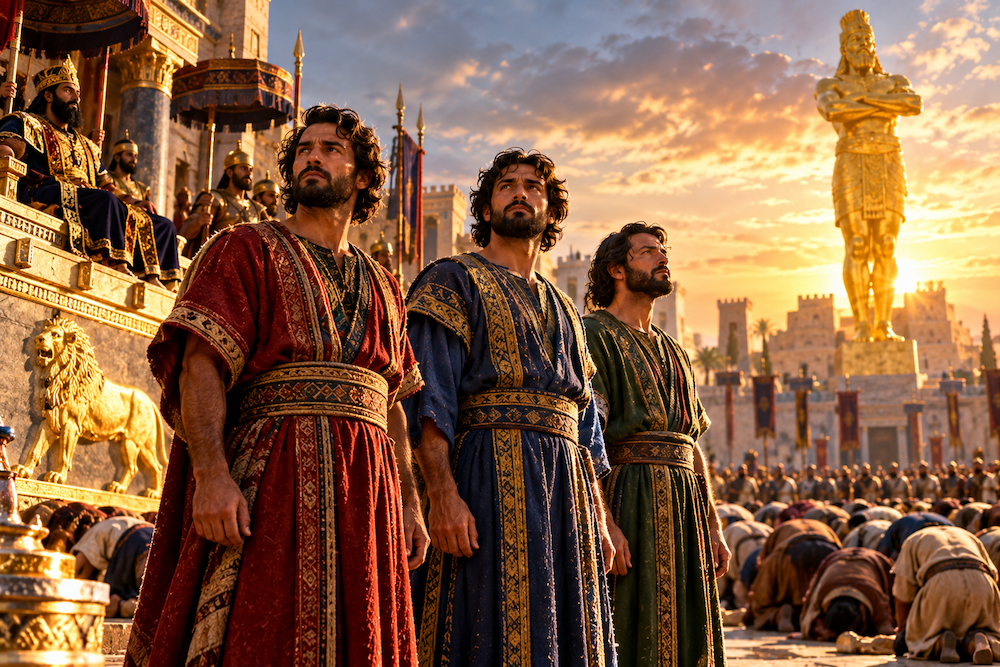
Imagine a vast gathering in ancient Babylon. At the sound of music, an entire crowd bends toward a towering golden image. Three men remain standing. They know the penalty: a blazing furnace. Yet Shadrach, Meshach and Abednego will not give the worship owed to God to an image commanded by a king. Daniel 3 tells what happened next—and reveals a kind of faith that does not depend on a guaranteed escape.
Nebuchadnezzar’s Golden Image and the Command to Worship
King Nebuchadnezzar erected a golden image on the plain of Dura in the province of Babylon. Daniel 3:1 gives its dimensions as sixty cubits high and six cubits wide—approximately 27 metres by 2.7 metres using a common cubit estimate. The Bible does not say whether the image represented the king, a deity or something else, nor does it identify the precise location of Dura.
Why Everyone Was Expected to Bow
The king summoned officials from across his administration. A herald ordered people of every nation and language to fall down and worship when the instruments sounded (Daniel 3:2–6). The threat was unmistakable: refusal meant immediate death in a burning furnace. This was not simply a public ceremony; worship was being demanded through imperial power.
Why Shadrach, Meshach and Abednego Would Not Worship the Idol
Certain Chaldeans accused the three Jewish administrators of refusing the king’s command (Daniel 3:8–12). The men were known by Babylonian names, but Daniel 1:6–7 identifies their Hebrew names as Hananiah, Mishael and Azariah. Their outward circumstances had changed in exile; their allegiance to the God of Israel had not.
The King Offers a Second Chance
Nebuchadnezzar, furious, summoned them and offered another opportunity to bow. He then asked what god could deliver them from his hands (Daniel 3:13–15). Their answer was respectful but unwavering. They neither threatened the king nor pleaded for an exemption. They simply refused to make obedience to God negotiable.
What Does “But If Not” Mean in Daniel 3:18?
Daniel 3:17 (KJV) declares, “Our God whom we serve is able to deliver us from the burning fiery furnace.” Then comes the decisive qualification: “But if not … we will not serve thy gods, nor worship the golden image which thou hast set up” (Daniel 3:18, KJV).
Faith Without a Guaranteed Outcome
Those three words—“But if not”—are the heart of the story. The men believe God is able to rescue them. They do not claim to know that he will. Their obedience is not a bargain: rescue is not the price God must pay for their loyalty. They will worship him even if their faithfulness costs their lives.
What Happened When the Three Men Were Thrown into the Fiery Furnace?
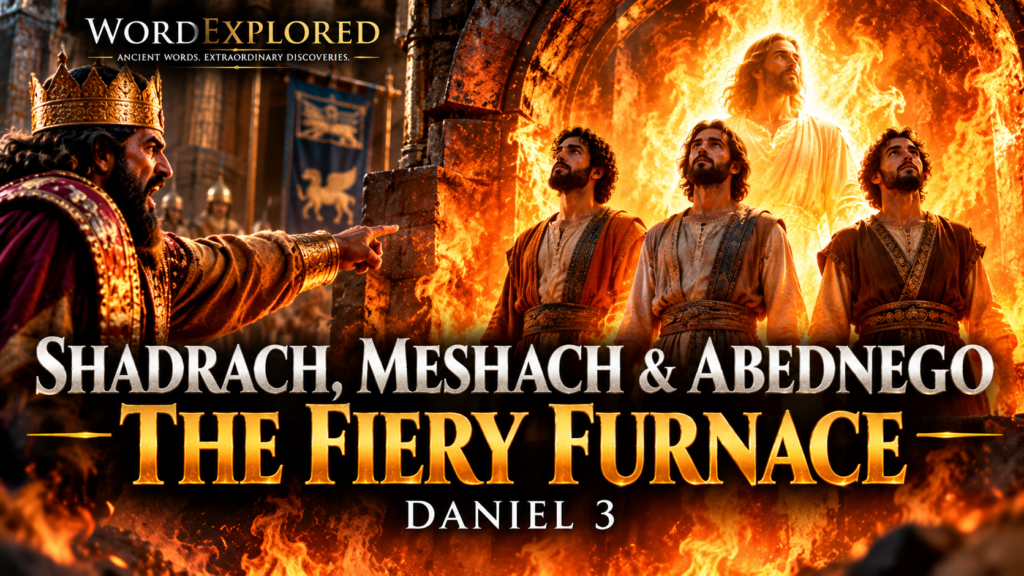
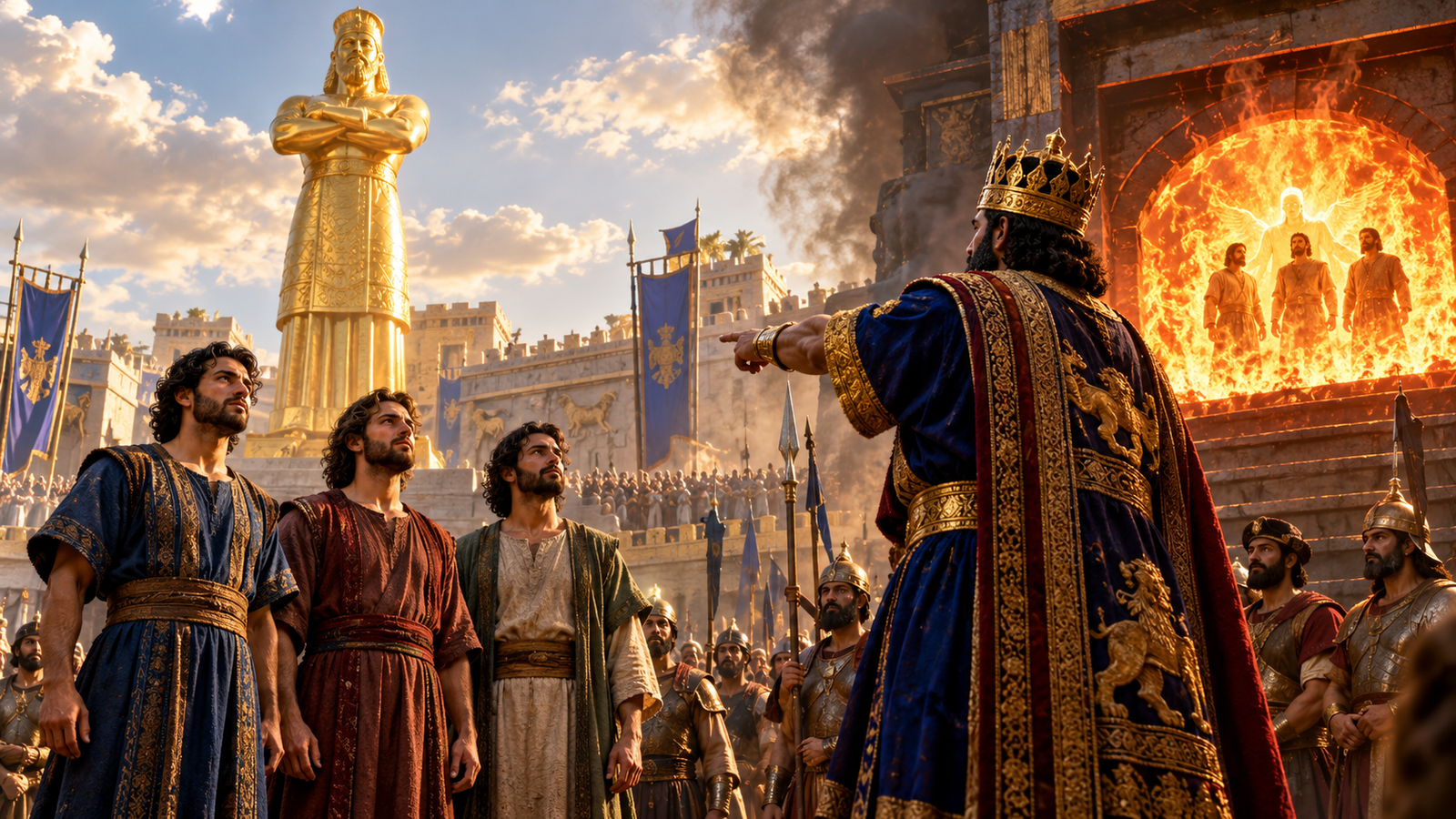
The king ordered the furnace heated “seven times more” than usual (Daniel 3:19, KJV). This communicates extreme heat; Scripture provides no measured temperature. Soldiers bound the three men in their clothes and carried out the sentence. The flames were so fierce that the soldiers who took them to the furnace died, while the three fell bound into the fire (Daniel 3:20–23).
The narrative deliberately places the king’s overwhelming force beside the apparent helplessness of the prisoners. Human authority had done everything it could. Yet the account was not over.
Who Was the Fourth Figure in the Fire?
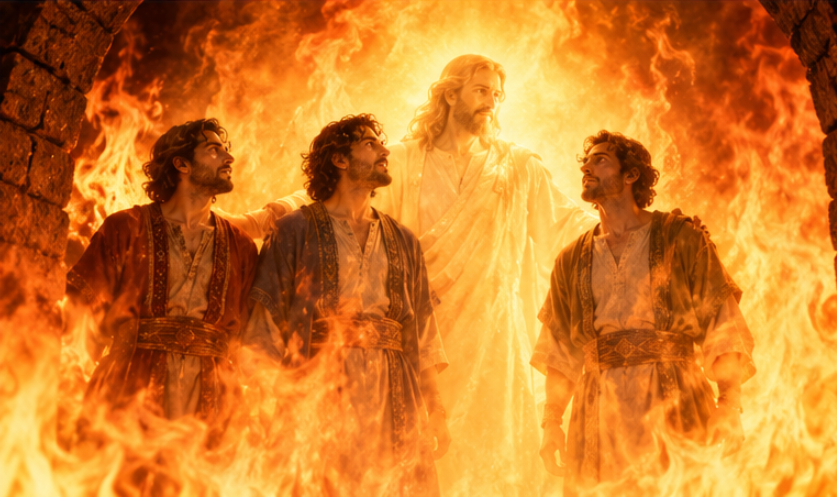
Nebuchadnezzar suddenly rose in astonishment. He had ordered three men thrown into the furnace, but now he saw four walking unbound and unharmed among the flames (Daniel 3:24–25). The KJV records the king describing the fourth as “like the Son of God.” The underlying Aramaic can also be understood as “a son of the gods” or a divine being, reflecting the language of a pagan king.
Was the Fourth Figure an Angel or Jesus Christ?
Christians have long discussed whether the fourth figure was an angel or a pre-incarnate appearance of Christ. Daniel 3:28 reports Nebuchadnezzar saying that God had “sent his angel.” Some Christian readers understand the event as a manifestation of Christ, but the chapter does not explicitly settle that identification. The central point is clear: God intervened, and the men were not alone in the furnace.
How Did the Men Emerge Without Even the Smell of Smoke?
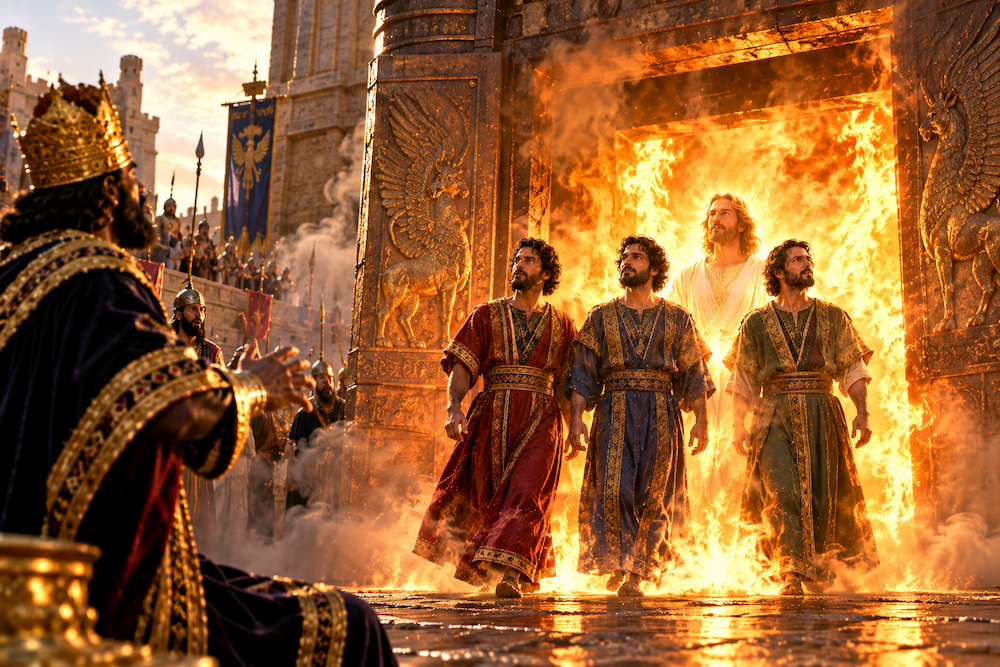
When Nebuchadnezzar called them out, the officials inspected the men. Their bodies were unharmed, their hair unsinged, their garments unchanged and not even the smell of fire had passed onto them (Daniel 3:26–27). The account describes complete preservation, not merely a narrow escape. The king praised their God and promoted them, though the chapter does not establish that his later religious commitment was permanent.
Extraordinary Details in Daniel 3 That Are Easy to Miss
The Golden Image’s Identity Is Never Given
Although the image’s size is stated, its precise subject and construction are not. Illustrations of a particular god or an unmistakable portrait of Nebuchadnezzar are artistic reconstructions, not confirmed facts.
Daniel’s Absence Is Not Explained
Daniel does not appear in this chapter. Scripture does not tell us where he was during the dedication, and it gives no basis for claiming that he bowed.
The Furnace’s Heat Is Not a Scientific Reading
The phrase “seven times” stresses the king’s rage and the severity of the sentence. It should not be converted into an exact temperature. The death of the soldiers underscores the danger.
The Story Was Preserved in Aramaic
Daniel 3 belongs to the Aramaic section of Daniel (2:4b–7:28). That matters particularly when interpreting the king’s description of the fourth figure; translation choices should be acknowledged rather than hidden.
What Does the Fiery Furnace Teach About Faith and God’s Presence?
The three men refuse idolatry because worship belongs to God alone (Exodus 20:3–5). Their courage is not a technique for obtaining safety. Hebrews 11 describes both astonishing rescues and faithful people who endured suffering. Daniel 3 therefore invites trust in God’s character even when the outcome remains unknown.
Faithful Conviction Without Hostility
Their response is firm but not violent. They neither surrender their convictions nor retaliate against the king. For Christians today, the account encourages integrity, humility and the willingness to accept consequences when obedience to God is genuinely at stake.
God’s Presence Does Not Eliminate Every Trial
The fourth figure is a striking image of divine help in suffering. Isaiah 43:2 offers a related biblical picture of God’s presence through fire, but neither passage should be turned into a universal promise that believers will never be harmed. Christian hope rests ultimately in God, not in certainty about immediate circumstances.
PERSONAL REFLECTION
Where am I tempted to follow a crowd rather than act with integrity? What changes in my prayers when I say, “God is able—but if not, I will still trust him”? How can I stand firm without treating others with contempt?
PRAYER
Lord God, give me courage to remain faithful when doing what is right is costly. Teach me to trust your wisdom rather than demand a particular outcome. Help me hold my convictions with humility, remember your presence in difficulty and worship you with an undivided heart. Amen.
QUESTIONS MANY PEOPLE ASK
Why did the three men refuse to bow?
The king demanded worship of an image, conflicting with Israel’s command to worship God alone (Daniel 3:12, 18; Exodus 20:3–5).
What does “but if not” mean?
They trusted God’s ability to rescue them without claiming he had promised to do so in that moment (Daniel 3:17–18).
Who was the fourth person in the furnace?
The king saw a fourth figure and later said God had sent his angel. Identifying the figure specifically as Christ is a Christian interpretation, not an explicit statement of the narrative.
Why was Daniel not in the furnace?
Daniel 3 does not say where Daniel was. We should not invent a reason for his absence.
Was the golden statue Nebuchadnezzar?
The chapter does not identify the image’s subject. That popular suggestion is possible but unproven.
Did the fire kill the guards?
Yes. Daniel 3:22 says the flames killed the soldiers who carried out the order.
Does the story promise believers will always be rescued?
No. The men explicitly accepted the possibility of death. Their faithfulness was unconditional.
WATCH THE STORY • LISTEN DEEPER
See this extraordinary account come alive in the cinematic WordExplored video featured above. Then continue the journey with our in-depth podcast below, where Daniel and Rachel explore the historical setting, the meaning of “but if not,” the mystery of the fourth figure and the lessons of Daniel 3 in greater detail.
CONTINUE EXPLORING
Read Daniel 1–3 for the wider story of faithfulness in exile, then explore Daniel 6 and Hebrews 11 for more on courage, perseverance and trust in God. Add verified internal WordExplored links to related published articles.
The Fiery Furnace
Discover the extraordinary faith of Shadrach, Meshach and Abednego as they refuse to bow before King Nebuchadnezzar's golden image. Explore their courage, God's miraculous deliverance and the powerful lessons of Daniel 3.
▶ LISTEN TO THE STORY