

The Bible Story of Love Beyond Boundaries
Why Did Jesus Tell the Parable of the Good Samaritan?
A wounded man lies helpless on a dangerous road. A priest sees him and walks past. A Levite does the same. Then someone the audience might least expect—a Samaritan—stops, kneels and helps. Jesus told this unforgettable parable not merely to praise kindness, but to confront a much harder question: where do we draw the line around the people we are willing to love?
The answer begins before the traveller ever appears. In Luke 10:25–37, an expert in the law approaches Jesus with a question about eternal life. By the end, Jesus has transformed a debate about who qualifies as a neighbour into a command to become one.
What Did Jesus Mean by “Who Is My Neighbour”?
The Question About Eternal Life
Luke tells us that an expert in the law stood up to test Jesus: “Master, what shall I do to inherit eternal life?” (Luke 10:25, KJV). Jesus directed him back to Scripture: what did the law say, and how did he read it?
The man answered with two great commands: love God with all your heart, soul, strength and mind, and love your neighbour as yourself (Luke 10:27; see Deuteronomy 6:5 and Leviticus 19:18). Jesus affirmed his answer. The problem was not that the man lacked the right words. It was whether he would live by them.
The Question That Tried to Set a Limit
Luke then reveals the motive behind the follow-up: the man wanted to justify himself. “And who is my neighbour?” he asked (Luke 10:29, KJV). If the category of neighbour could be narrowly defined, perhaps the obligation to love could be limited too. Instead of offering a neat boundary, Jesus told a story.

What Happened on the Road from Jerusalem to Jericho?
A Traveller Left Half Dead
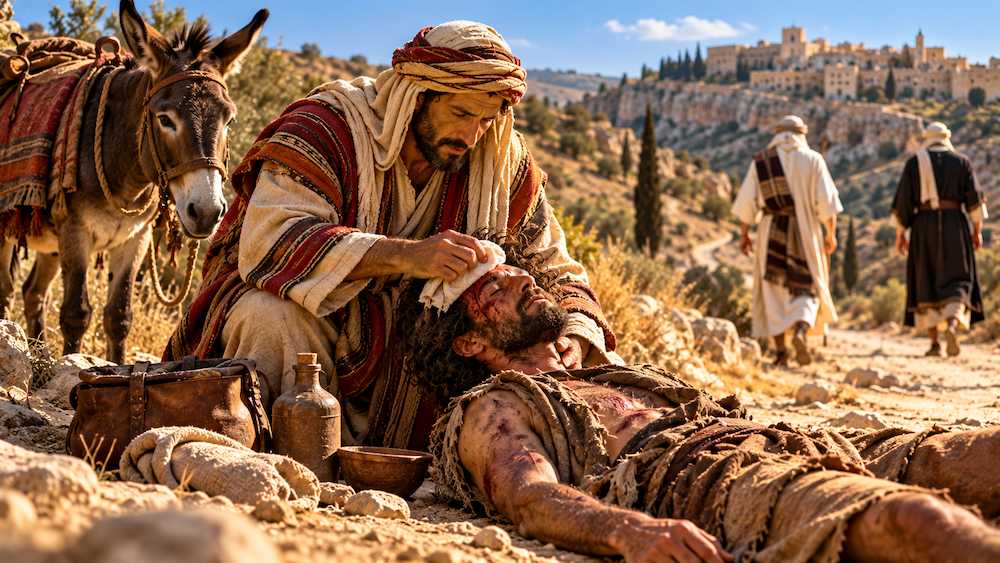
A man was travelling down from Jerusalem to Jericho when robbers attacked him. They stripped him, beat him and left him half dead (Luke 10:30). Jesus does not identify the victim’s nationality, profession or religious background. We are given no credentials to assess before deciding whether he deserves help.
The journey descended from the Judean highlands toward the Jordan Valley through rugged terrain. The steep landscape helps us picture the traveller’s isolation, although Jesus does not identify a precise ambush site.
Why Did the Priest and Levite Pass By?
First a priest came along. He saw the wounded man and passed by on the other side. Then a Levite approached, saw him and also passed by (Luke 10:31–32). The repetition matters: neither failed to notice the need. Both continued without helping.
What the Bible Does Not Tell Us
Jesus does not explain their motives. Fear, haste and concerns about ritual purity are sometimes proposed, but the text does not confirm any of them. The contrast is between seeing suffering and responding to it—not between two invented psychological explanations.
Why Was the Samaritan the Unexpected Hero?
Compassion Across a Deep Social Divide
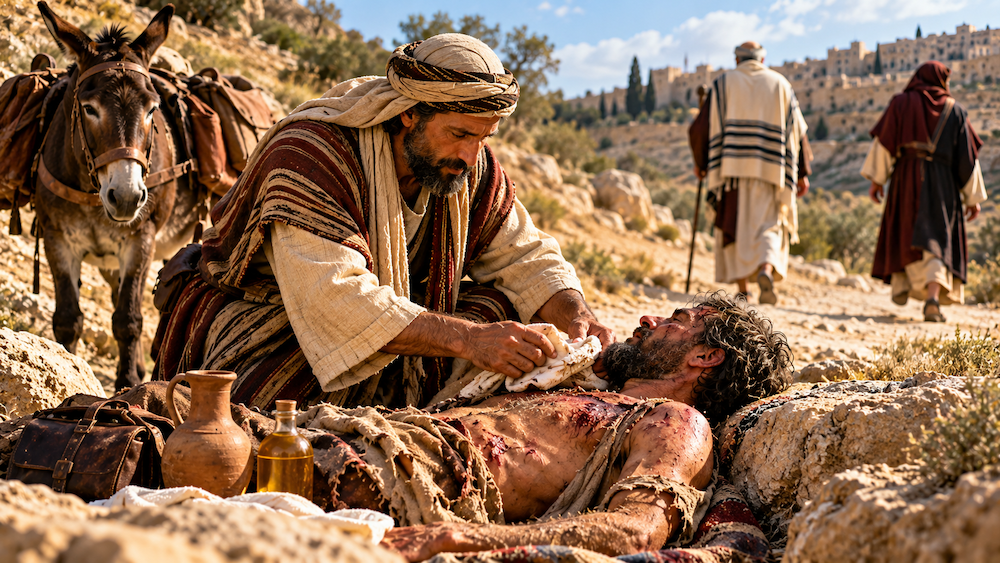
Then a Samaritan arrived. Relations between Jewish and Samaritan communities included longstanding religious disagreements and social tensions. For many of Jesus’ hearers, the identity of the compassionate traveller would have been surprising. Yet Luke says simply that when he saw the wounded man, “he had compassion on him” (Luke 10:33, KJV).
The Samaritan did not merely feel sympathy from a distance. He moved toward the man whom others had avoided. Jesus makes the outsider the example of neighbour-love without claiming that every person from either community behaved alike.
How the Samaritan Turned Mercy into Action
He bound the man’s wounds, pouring in oil and wine; set him on his own animal; brought him to an inn; and cared for him (Luke 10:34). These are details of the ancient narrative, not modern medical instructions. The Samaritan’s care demanded time, supplies, transport and personal involvement.
Why Did He Give the Innkeeper Two Denarii?
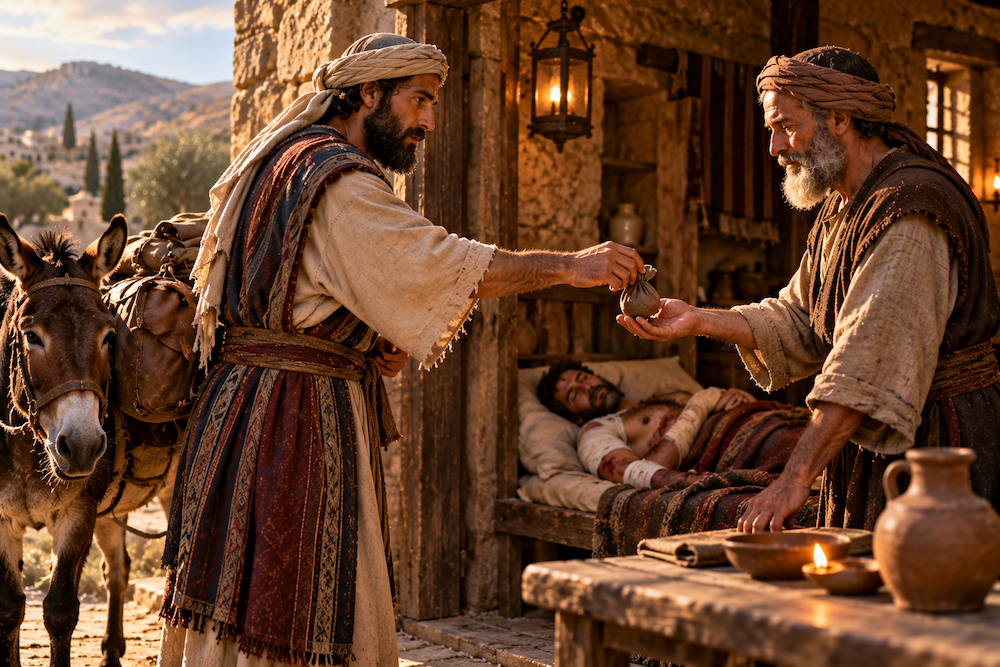
The next day, the Samaritan gave the innkeeper two denarii and promised to cover any additional expense when he returned (Luke 10:35). Jesus does not specify the precise cost of lodging or a modern equivalent. What matters is the open-ended commitment: the Samaritan made sure compassion continued even after he had to leave.
What Extraordinary Details Are Hidden in the Good Samaritan Story?
The Injured Man Has No Stated Identity
Jesus never says whether the victim was Jewish, Samaritan or from another community. That silence is striking. The wounded man is not introduced as someone whose background makes him worthy of rescue. His need is enough to place the moral question before the listeners.
The Road Really Does Go Down
The description of travelling “down” from Jerusalem to Jericho is geographically appropriate: Jerusalem stands far higher than Jericho. Even a small directional detail makes the setting vivid.
The Samaritan Did More Than a Single Good Deed
The parable follows the rescue beyond the roadside. Wound care, transport, shelter, money and a promise to return show that mercy is not a momentary impulse. It can involve sustained responsibility.
The Famous Title Was Not Spoken by Jesus
“The Good Samaritan” is the familiar later name of this parable. In Luke’s account, Jesus does not call the traveller “good.” He asks which person acted as a neighbour—a sharper and more personal question.
What Does the Good Samaritan Teach About Loving Your Neighbour?
Jesus Reverses the Original Question
The expert asked, “Who is my neighbour?” Jesus asked which of the three travellers “was neighbour unto him that fell among the thieves” (Luke 10:36, KJV). The man replied, “He that shewed mercy on him.” Jesus answered: “Go, and do thou likewise” (Luke 10:37, KJV).
The change is profound. The first question looks for a boundary around responsibility. The second looks for the character of the person who responds. Neighbour-love is not confined to familiar groups, shared beliefs or convenient circumstances.
Faith That Becomes Visible Through Mercy
The parable belongs to a conversation about loving God and neighbour, not a formula for purchasing salvation through good deeds. Its challenge is that religious knowledge without compassion is incomplete. James 2:14–17 likewise challenges a faith that speaks warmly about need but does nothing practical to meet it.
Mercy does not mean ignoring danger or abandoning wise boundaries. In our lives, practical love may involve food, transport, friendship, advocacy, support for those in need or calling qualified emergency help. The central question is whether we are willing to act.
Personal Reflection
Who have I seen in need but quietly found a reason to pass by? Are there people I consider outside my responsibility because they are different from me? What is one wise, practical act of mercy I can offer this week?
Prayer
Heavenly Father, open my eyes to those I might overlook. Give me compassion that moves beyond good intentions, courage to cross barriers of prejudice and wisdom to help responsibly. Teach me to love my neighbour as myself and to reflect Your mercy in the way I live. In Jesus’ name, Amen.
Questions Many People Ask
Where is the Good Samaritan story found in the Bible?
Jesus tells the parable in Luke 10:25–37, during a conversation with an expert in the law about eternal life and love of neighbour.
Why was the Samaritan’s kindness surprising?
Jewish and Samaritan communities had longstanding religious and social tensions. Jesus deliberately makes the Samaritan the person who demonstrates mercy.
Why did the priest and Levite ignore the injured man?
Luke says they saw him and passed by. Their precise reasons are not given, so explanations involving fear or ritual purity remain speculation.
Was the injured traveller Jewish?
The parable does not identify his ethnicity or religious background. That omission strengthens the point that mercy should not depend on someone’s group identity.
What were the oil, wine and two denarii for?
The Samaritan used oil and wine while tending the wounds and gave two denarii to the innkeeper for the traveller’s care, promising to cover further costs.
Does the parable teach that helping people earns salvation?
The story is part of a larger conversation about God’s law and eternal life. It teaches the lived expression of neighbour-love, not that one charitable act purchases salvation.
What does “Go, and do thou likewise” mean today?
Jesus calls his hearers to practise mercy. Today that can mean helping those in need through safe, thoughtful and practical action.
Continue Your Journey Through God’s Word
Experience this extraordinary Bible story in a whole new way. Watch the cinematic video above to see the story come alive, then listen to our in-depth WordExplored podcast below for fascinating historical insights, deeper biblical understanding and powerful lessons you may have missed.
WordExplored Deep-Dive Podcast (see below)
Join Daniel and Rachel for a thoughtful exploration of Luke 10:25–37, the surprising role of the Samaritan, the road to Jericho and Jesus’ challenge to put compassion into action.
Continue Exploring
The Good Samaritan is one part of Jesus’ wider teaching on mercy. Continue with Luke 6:27–36, where Jesus calls His followers to love their enemies; Leviticus 19:18 and 19:34, where neighbour-love extends beyond familiar circles; and James 2:14–17, which challenges faith without practical care. Discover more Bible stories and timeless lessons at WordExplored.com.
The Good Samaritan
Discover Jesus' unforgettable parable of compassion, kindness and loving your neighbour. Explore the powerful lessons of mercy, selfless love and what it truly means to help others in Luke 10:25–37.
▶ LISTEN TO THE STORY