The Flood, the Dove and God’s Rainbow Promise
Why Did God Tell Noah to Build an Ark?
What does the Bible really say happened when the floodwaters rose—and what did God promise when they finally receded? Behind the familiar picture of animals entering a wooden vessel is a far more searching account of human violence, divine judgment, extraordinary patience and enduring mercy. Genesis 6–9 follows Noah from a broken world to a renewed landscape beneath a rainbow, asking not only what happened, but what kind of God speaks and acts throughout the story.
Why Did God Send the Flood in Noah’s Time?
Genesis begins with a devastating moral diagnosis. Human wickedness had become great, and the earth was filled with violence (Genesis 6:5, 11–13). God is described as grieved by what humanity had become. This is not a story in which the Lord destroys a world over a minor mistake; the narrative confronts entrenched evil and its consequences.
How Did Noah Find Grace in a Corrupt World?
Against that darkness, Scripture offers a striking sentence: “But Noah found grace in the eyes of the LORD” (Genesis 6:8, KJV). Noah is described as righteous in his generation and as one who walked with God (Genesis 6:9). Yet Genesis does not call him sinless. Divine favour comes before the repeated descriptions of his obedience.
God instructed Noah to build an ark and promised to establish his covenant with him. Noah was to enter with his wife, his sons Shem, Ham and Japheth, their wives, and living creatures to preserve life (Genesis 6:14–21). The names of the four women are not given in Genesis.
How Big Was Noah’s Ark and How Were the Animals Saved?
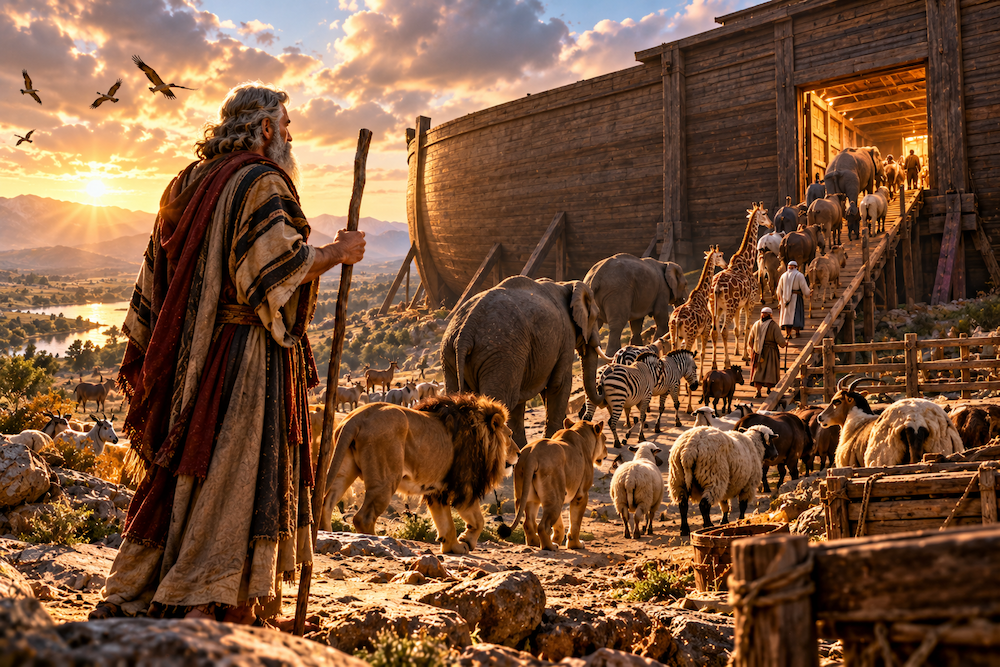
The ark was to measure 300 cubits long, 50 cubits wide and 30 cubits high, with rooms, a side entrance and three levels (Genesis 6:14–16). A cubit was an ancient unit whose length varied, so modern measurements are approximations rather than a blueprint verified by archaeology. The timber called “gopher wood” has not been identified with certainty.
Were There Really Only Two of Every Animal?
Genesis 6 describes the preservation of living creatures in pairs. Genesis 7 adds a more detailed distinction: seven pairs of clean animals and birds, and a pair of animals not classified as clean, as the Hebrew text is commonly understood (Genesis 7:2–3). The account is not a modern inventory of biological species. These details also prepare for Noah’s later sacrifice from the clean animals.
Noah obeyed the instructions he received. When the time came, the family and animals entered the ark. The narrative then adds a remarkable detail: “and the LORD shut him in” (Genesis 7:16, KJV). God, not Noah, is the decisive actor at the threshold of the flood.
How Long Did the Flood Last, and Where Did the Ark Rest?
The fountains of the great deep burst forth, the windows of heaven opened, and rain fell for forty days and forty nights (Genesis 7:11–12). The waters prevailed for 150 days (Genesis 7:24). These are not competing accounts of the same length of time: forty days describes the rainfall, while 150 days describes the waters’ prevailing. Some periods overlap, so simply adding every number together produces a misleading timeline.
Genesis describes the waters covering the mountains under the whole heaven and the destruction of life outside the ark (Genesis 7:18–23). Readers debate the geographical extent and physical mechanisms of the flood. Whatever view is taken, the text presents the catastrophe as comprehensive and solemn, not as an ordinary storm.
What Does “God Remembered Noah” Really Mean?
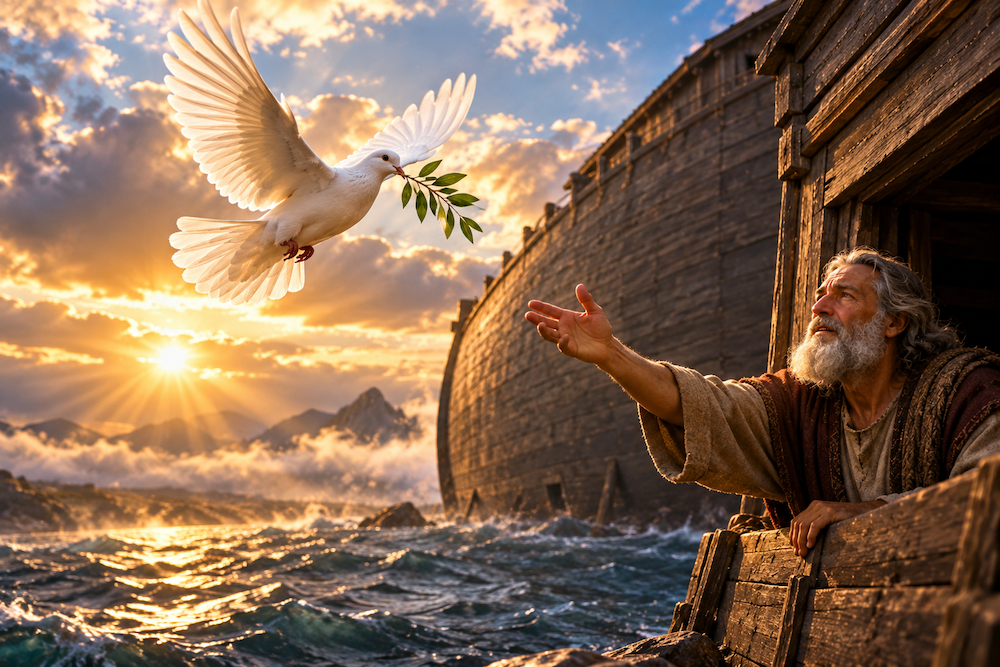
Then the narrative turns: “And God remembered Noah” (Genesis 8:1, KJV). This does not mean Noah had slipped from God’s mind. In biblical language, remembering often marks purposeful attention and action. God caused a wind to pass over the earth, the waters began to recede, and the ark came to rest on the “mountains of Ararat” (Genesis 8:1–4). The phrase refers to a region; it does not verify a particular modern summit or archaeological discovery.
Why Did Noah Send Out a Raven and a Dove?
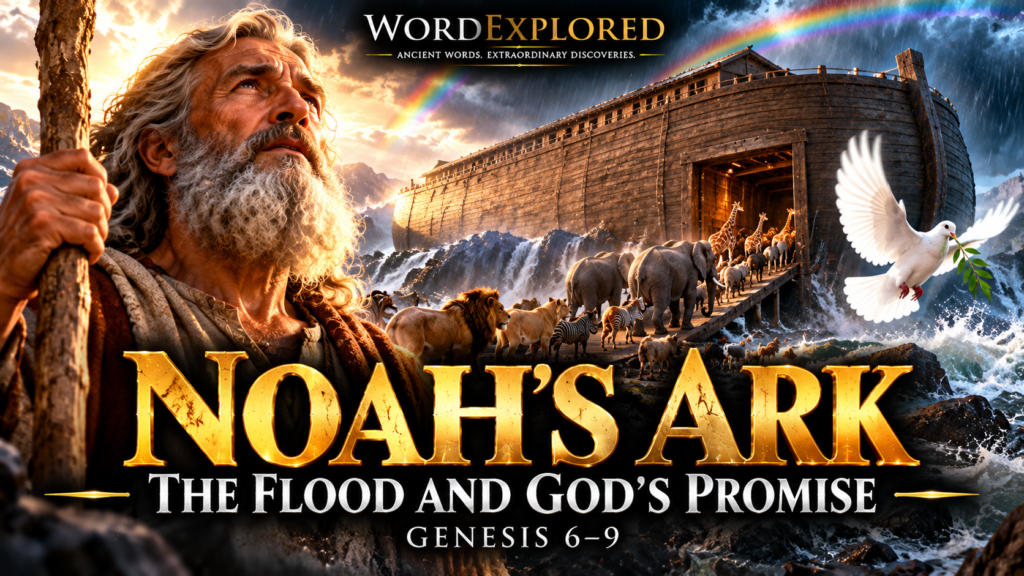
As the waters receded, Noah waited. First he released a raven, which went to and fro. Then he sent a dove, which returned because it found no resting place (Genesis 8:6–9). Seven days later the dove returned carrying a freshly plucked olive leaf. After another seven days, the dove did not return (Genesis 8:10–12).
What Did the Olive Leaf Mean?
The olive leaf was a tangible sign that vegetation was available and the land was recovering. It was not a spoken prophecy, nor did it mean the family could immediately leave. Noah waited until the earth was dry and God instructed them to go out (Genesis 8:13–19). His obedience included waiting as well as building.
What Did God Promise Noah When the Rainbow Appeared?
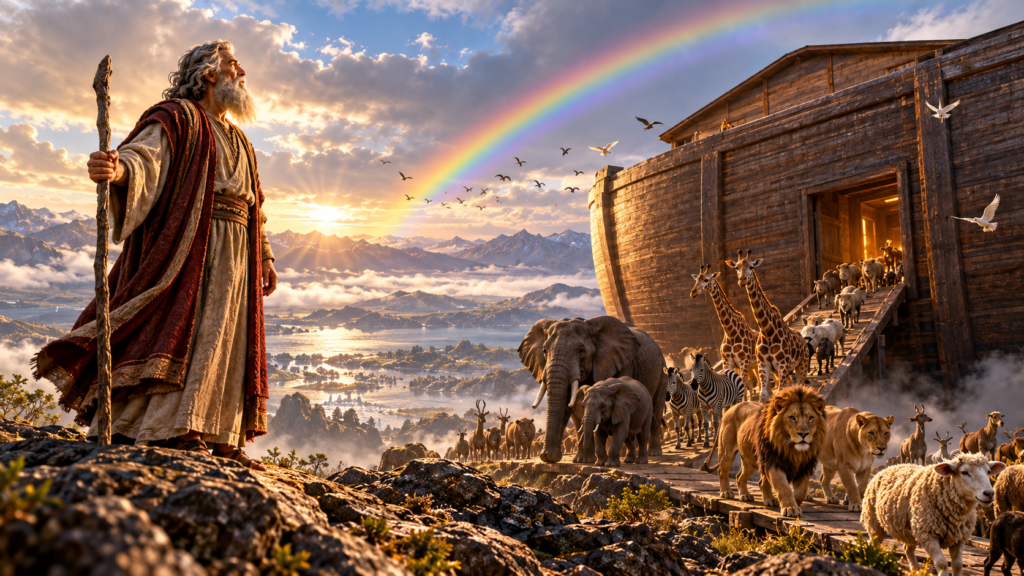
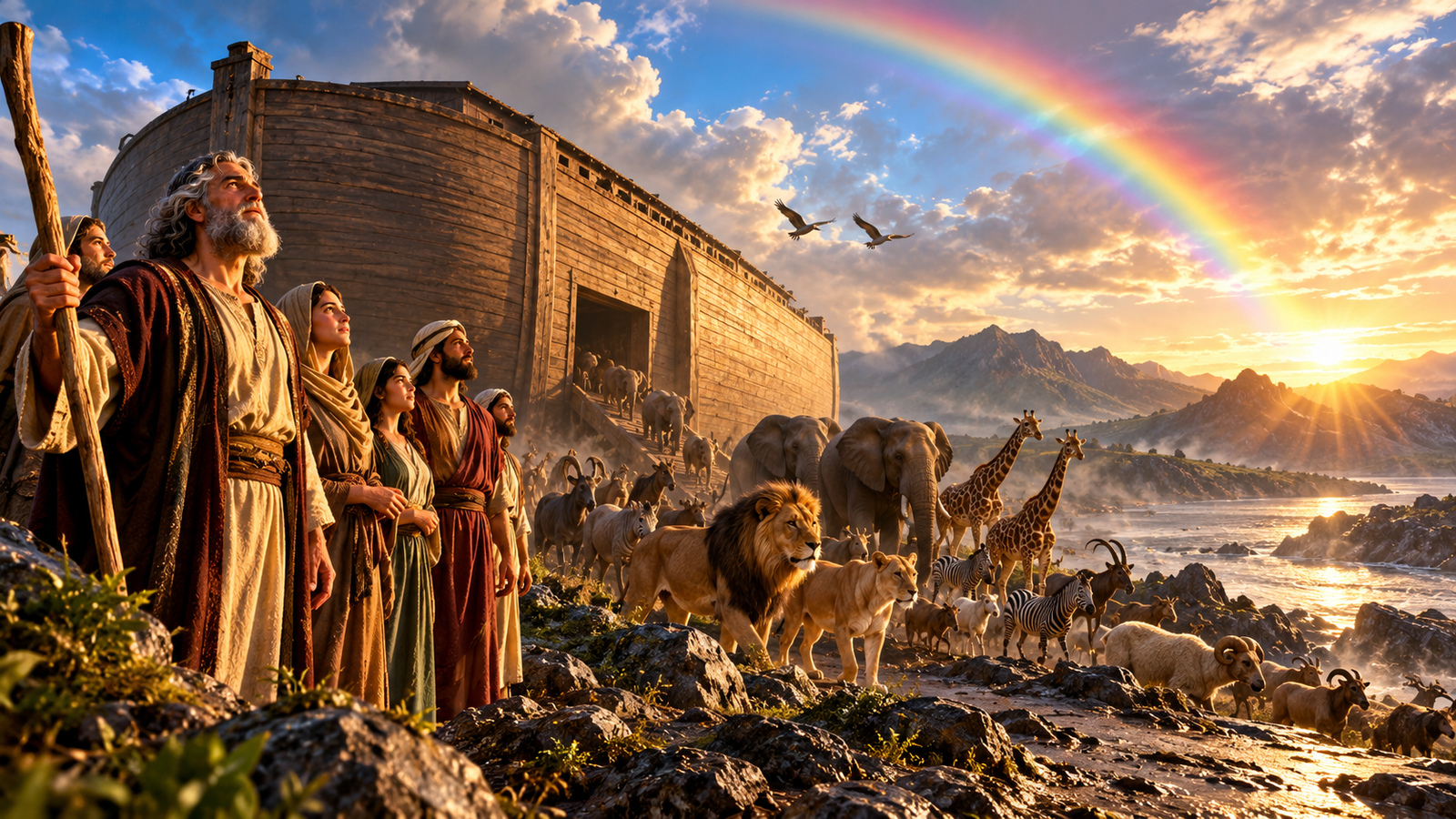
When Noah emerged, he built an altar and offered sacrifices. God promised the continuing rhythm of seedtime and harvest, cold and heat, summer and winter, day and night while the earth remains (Genesis 8:20–22). In Genesis 9, God blessed Noah’s family, affirmed the value of human life because people bear God’s image, and established a covenant with Noah, his descendants and every living creature.
Why Is the Rainbow a Sign of God’s Covenant?
“I do set my bow in the cloud, and it shall be for a token of a covenant between me and the earth” (Genesis 9:13, KJV). The promise is precise: God would never again destroy all flesh by the waters of a flood in the manner described (Genesis 9:11, 15). It is not a promise that no storm, local flood or other disaster will ever occur. The bow points to God’s pledge to the living world, not merely to Noah alone.
What Extraordinary Details Are Hidden in the Noah’s Ark Story?
The Ark and Moses’ Basket Share a Hebrew Word
The Hebrew word often transliterated tevah is used for Noah’s ark and for the basket that carried the infant Moses through water (Exodus 2:3, 5). The connection invites reflection on preservation, although the two stories are distinct.
Ancient Flood Stories Are Similar—but Not Identical
Mesopotamian works such as Atrahasis and the Epic of Gilgamesh also preserve flood narratives. The parallels are fascinating, but Genesis differs significantly in its presentation of one sovereign God who judges violence and makes an enduring covenant. Literary comparisons do not by themselves settle questions about the flood’s historical or geological extent.
The Flood Did Not Remove Human Sin
Genesis 8:21 recognises the continuing problem of the human heart. Even after the covenant, Genesis 9 recounts Noah’s drunkenness and a troubling family episode. The account refuses an easy “everything was perfect afterward” ending. The later curse concerns Canaan specifically, and using this passage to justify racial oppression is a serious distortion of the text.
What Does Noah’s Ark Teach Christians About Faith and God’s Mercy?
Noah’s story holds judgment and grace together. God takes violence seriously, yet preserves life and makes a promise extending to future generations and living creatures. Hebrews 11:7 presents Noah’s obedient preparation as an expression of faith. It does not teach that believers will always escape suffering.
How Does Noah’s Story Point Toward the New Testament?
Jesus refers to the days of Noah when teaching about the unexpectedness of the Son of Man’s coming (Matthew 24:37–39). First Peter 3:18–22 develops a theological comparison involving the flood, baptism and Christ’s saving work. These later biblical connections deepen Christian reflection, but Genesis itself does not explicitly identify the ark as Christ or assign secret meanings to every timber and measurement.
The enduring challenge is not to predict every disaster or condemn those who suffer them. It is to respond to God with integrity, patient trust, care for neighbours and gratitude for the life entrusted to us.
Personal Reflection
Where have I become comfortable with something that Scripture calls wrong? What does faithful patience look like when an answer seems slow? How might God’s concern for every living creature shape the way I treat people, animals and the world around me?
Prayer
Lord God, help me take wrongdoing seriously without losing sight of Your mercy. Give me courage to live faithfully, patience to wait when the way forward is unclear, and gratitude for Your care for creation. Teach me to trust the promises You have truly made and to honour every person made in Your image. In Jesus’ name, Amen.
Questions Many People Ask
How many people were on Noah’s ark?
Eight: Noah and his wife, their three sons, and their sons’ wives (Genesis 7:13; 1 Peter 3:20).
How old was Noah when the flood began?
Genesis 7:6 says Noah was 600 years old when the flood came.
Did it rain for forty days or did the flood last 150 days?
Both numbers appear in Genesis. Forty days describes the rain; 150 days describes the period the waters prevailed (Genesis 7:12, 24).
Did Noah take only two of every animal?
Genesis gives a general description of pairs, then specifies additional clean animals and birds in Genesis 7:2–3.
Was Noah’s ark found on Mount Ararat?
Genesis mentions the mountains of Ararat, but no claimed modern ark discovery has gained broad scholarly verification.
Why did the dove return with an olive leaf?
The leaf indicated that vegetation was becoming available as the waters receded (Genesis 8:11).
What does the rainbow promise in the Bible?
It signifies God’s covenant never again to destroy all flesh by a flood as described in Genesis 9:11–17; it does not promise an end to all natural disasters.
Experience Noah’s extraordinary story in a new way. Watch the cinematic WordExplored video above to see the biblical events brought to life, then listen to our in-depth podcast below for fascinating historical insights, deeper Scripture exploration and important details you may have missed.
WordExplored Deep-Dive Podcast
Explore Noah’s faith, the long wait aboard the ark, the ancient flood traditions and the remarkable meaning of God’s covenant in our extended conversation – see below.
Continue Exploring
The story of Noah invites us to keep reading. Explore Genesis 1–3 for the Bible’s account of creation and the human condition, Hebrews 11 for the witness of faith, and 1 Peter 3:18–22 for the New Testament’s reflection on the flood and Christ. Every passage opens another opportunity to discover the depth of God’s Word.
Noah and the Ark
Discover the extraordinary story of Noah, the great flood and God's promise to humanity. Explore the remarkable lessons of faith, obedience, judgement and hope found in Genesis 6–9.
▶ LISTEN TO THE STORY